Buying a house in Menorca is not just about choosing a location by the sea: it also involves finding an environment and a way of living that fits each individual.
The island has a very distinct personality, and although its dimensions allow for traversing it from end to end in a short time, each area offers a different way to experience it. Waking up in front of the bay of Fornells is not the same as having a villa near the southern coves, living by the port of Maó, or choosing a property surrounded by countryside and the traditional dry stone walls of Menorca.
This diversity is precisely one of the great peculiarities of the Menorcan residential market. There are contemporary villas, traditional whitewashed houses, apartments in seaside developments, and old llocs that preserve the structure of the island's rural homes.
In all of them, a similar understanding of architecture emerges, with varying degrees of intensity: natural materials, outdoor spaces, protection from the wind, and a very close relationship between the house and the landscape.
Where to buy a house in Menorca: one island, different ways of living
For those seeking a property by the sea, the northern coast offers an experience particularly tied to the landscape and navigation. Fornells is probably one of the best examples. The old fishing village retains a more domestic scale than other coastal areas, and its bay shapes daily life: water-facing terraces, boats, restaurants, and promenades by the port are part of an environment where the sea is present year-round.
In the surroundings, Playas de Fornells offers a residential character, with properties by the sea in Menorca and homes designed for enjoying the coast with privacy. Also in the north, Son Parc and Arenal d’en Castell present a different profile, open and relaxed, with holiday homes, apartments, and villas around natural spaces and the coast. In this same environment, Coves Noves has gained prominence within the northern Menorcan residential market. Its elevated position, views of the Mediterranean, and proximity to Arenal d’en Castell, the port of Addaia, and Son Parc have favored the emergence of new projects and contemporary villas. The current offerings precisely reflect this evolution, with newly built homes and plots designated for single-family projects.
The coast changes character as we approach the east and southeast of the island. The surroundings of Maó and Cala Llonga are particularly interesting for those who want to be close to services while enjoying a home linked to the sea. Cala Llonga overlooks the port of Maó from a privileged position, while Maó itself offers another possibility: living in a traditional house within an urban nucleus that remains active throughout the year. It is an alternative that allows for a combination of architecture, commerce, gastronomy, and daily life without sacrificing proximity to the Mediterranean.
Further south, there are nuclei such as Binibeca, Binissafúller, Cap d’en Font, Biniancolla, S’Algar, Alcaufar, or Punta Prima, each with its own personality. Here, villas, white houses, and properties with gardens and terraces predominate, many designed to enjoy the outdoors for a good part of the year.
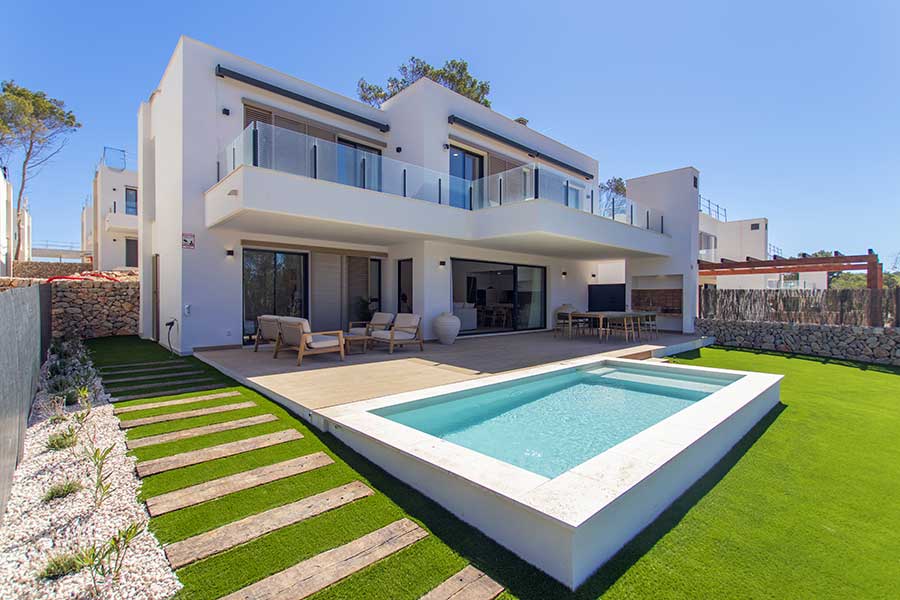
The coast of Ciutadella: villas, coves, and Mediterranean architecture
In the west, Ciutadella provides another of Menorca's major residential hubs. The city itself offers a different experience, with traditional houses, historic buildings, and an urban life that continues year-round. For those looking to buy a home with character, its streets and traditional neighborhoods allow for finding properties where architecture plays a leading role, from stately homes in the historic center to contemporary residences in residential areas close to the center, an interesting option for those wishing to combine urban life with proximity to the sea.
In the vicinity of Ciutadella, Cala en Blanes and Cala Morell can also be found, two places with very distinct characters. Cala en Blanes has a more residential and family-oriented profile, while Cala Morell stands out for its rocky landscape and the sense of isolation offered by its coast. In the southwestern tip, Cala en Bosch and Son Xoriguer complete this stretch of homes by the sea, with villas, apartments, and houses designed around terraces, pools, and outdoor spaces.
The difference between these areas is not only in the distance to a beach. It lies in the orientation, the landscape, the degree of privacy, the type of development, and, above all, in the way the home is utilized. In Menorca, a terrace can practically be another room of the house for a good part of the year.
An architecture that explains how life is lived in Menorca
There is something that makes many Menorcan properties have a recognizable identity even when they have been built recently: the relationship with the materials and forms of traditional architecture.
Marès, a characteristic sandstone of the Balearics, has played a fundamental role in the construction of the island. Its presence is appreciated in walls, facades, vaults, and interior elements, and it continues to be used in contemporary projects that seek to maintain a connection with local architecture. In Fornells, for example, some residential projects have reinterpreted marès alongside Arabic tile roofs, wood, and passive systems such as cross ventilation.
It is also impossible to understand Menorca without its dry stone walls. They are not merely a decorative element of the landscape: for centuries, they served to delineate properties, protect crops from the wind, organize agricultural operations, and meet various needs of the countryside. The traditional dry stone technique is part of the island's cultural heritage and remains one of its most recognizable landscape features.
Additionally, there are whitewashed facades, wooden carpentry, traditional shutters, and certain elements inherited from British influence, such as guillotine windows. These details explain why a Menorcan house may seem simple at first glance yet possess an architecture extraordinarily adapted to its surroundings.
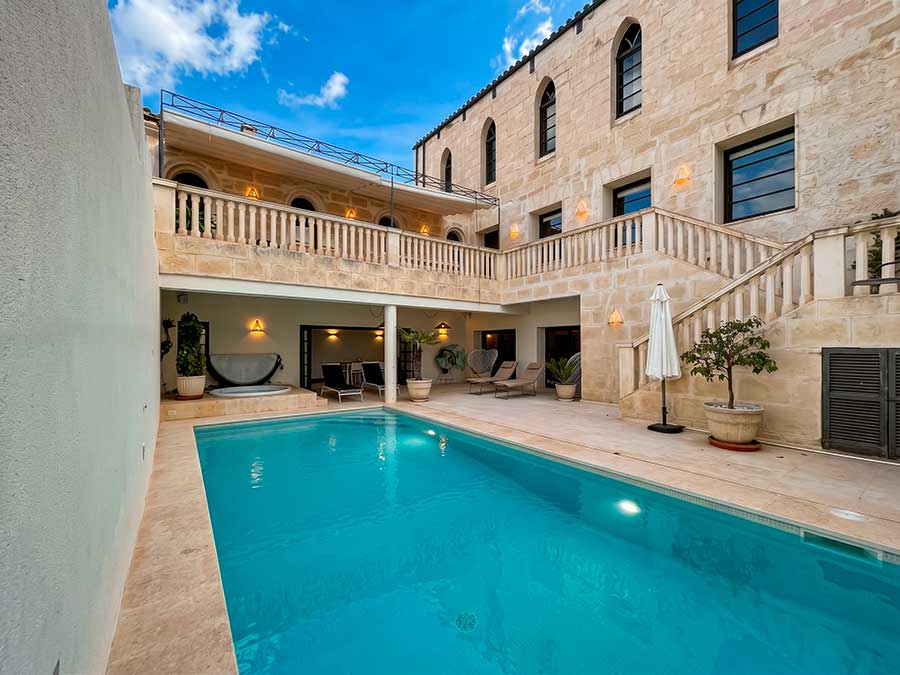
From a villa by the sea to a lloc in the countryside
The housing available in Menorca does not conform to a single model. Coastal villas are probably the most associated image with the island: independent properties, with gardens, pools, terraces, and open spaces towards the landscape. In the best locations, the architecture seeks precisely to make the exterior part of the experience of the house.
There are also apartments and townhouses in coastal developments, a practical option for those prioritizing proximity to the sea and a second residence with easier maintenance. In other areas, especially around traditional nuclei, village houses and homes allow for enjoying a more everyday Menorca, with shops, restaurants, and neighbors year-round.
And then there is the countryside, which perhaps offers the most different experience. The old Menorcan rural estates, known as llocs, are part of an agricultural structure where the home was related to pens, auxiliary buildings, land, and dry stone walls. Some of these properties have been rehabilitated, preserving stone walls, wooden beams, patios, and original elements, while incorporating contemporary kitchens, large living spaces, pools, and all modern comforts.
For those who do not need to have the sea in front of their house, buying a finca in Menorca can mean precisely the opposite of isolation: gaining space, silence, and a much deeper relationship with the Menorcan landscape. Here, the Mediterranean does not necessarily appear from a terrace, but in the light, in the wind, in the rural paths, and in that stone landscape that changes with the seasons.
Choosing a house in Menorca is choosing a lifestyle
Therefore, discussing where to buy a house in Menorca should not be reduced to pointing out certain areas on a map. The choice has much to do with the type of life one wants to build around the property. To delve deeper into the island's attractions, you can also consult our article on why to buy a house in Menorca.
Those who imagine mornings of sailing and tranquil afternoons by the port will likely find their place in the surroundings of Fornells or Addaia. Those seeking a villa surrounded by a garden and wanting to have the southern coves nearby may feel more identified with Sant Lluís and its coastline. For those who prefer to combine sea, services, and the life of a city with history, the surroundings of Ciutadella or Maó offer a different dimension. And for those who value privacy, land, and traditional architecture above all, a rustic finca in Menorca may be a much more personal choice.
More than simply purchasing a property, it is about finding a particular way of life on the island: overlooking the Mediterranean, beside a harbour, among dry-stone walls or in a traditional house where time seems to move at a different pace. Menorca offers all these possibilities while preserving what makes it so distinctive: architecture closely connected to the land, a natural and rural landscape of great value that led UNESCO to designate the island a Biosphere Reserve in 1993, and a Mediterranean lifestyle enjoyed both indoors and outdoors.
Discover the properties that could become your next home in Menorca and find the place that best fits your way of living on the island. Our real estate advisors will be by your side to understand your preferences, show you the different possibilities, and accompany you throughout the entire process of searching for and selecting your property in Menorca.
Contact our team
 Castellano
 Català
 English
 Francais
 Italiano
 русский